Process Concept
Process : a program in execution; process execution must progress in sequential fashion
program code (text section), program counter, processor registers, Stack containing temporary data, Data section containing global variables, Heap containing memory dynamically allocated during run time
One program can be several processes

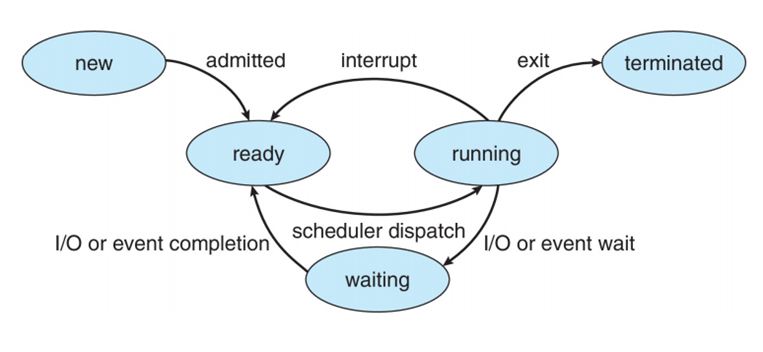
Process State
New : The process is being created
Running : Instructions are being executed
Waiting : The process is waiting for some event to occur
Ready : The process is waiting to be assigned to a processor
Terminated : The process has finished execution
Process Control Block (PCB)
Process state : running, waiting ...
Program counter : location of instruction to next execute
CPU registers : contents of all process-centric registers
CPU scheduling information : priorities, scheduling queue pointers
Threads
Process has a single thread of execution
Multiple locations can execute at once (Multiple threads of control => threads)
Must then have storage for thread details, multiple program counters in PCB
Process Scheduling
Process scheduler selects among available processes for next execution on CPU core
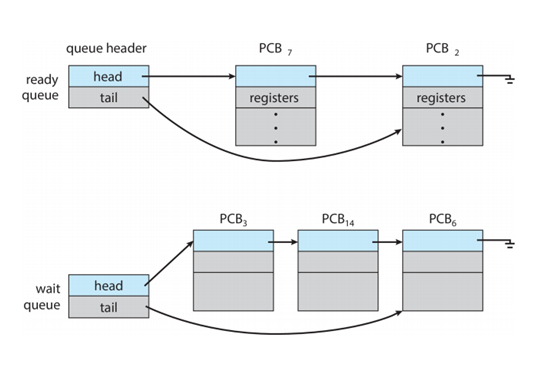
Ready queue : set of all processes residing in main memory, ready and waiting to execute
Wait queues : set of processes waiting for an event

CPU Switch
A context switch occurs when the CPU switches from one process to another
When CPU switches to another process, the system must save the state of the old process and load the saved state for the new process via a context switch
Context of a process represented in the PCB

Multitasking in Mobile Systems
Some mobile systems allow only one process to run, others suspended
Single foreground process : controlled via user interface
Multiple background processes : in memory, running, but not on the display, and with limits
Process Creation
Parent process create children processes, which, in turn create other processes, forming a tree of processes
Generally, process identified and managed via a process identifier (pid)
In UNIX
fork() system call : creates new process
exec() system call used after a fork() to replace the process’ memory space with a new program
Parent process calls wait() for the child to terminate
Process Termination
Process executes last statement and then asks the operating system to delete it using the exit() system call
Returns status data and pid of the terminated process from child to parent (via wait())
Process’ resources are deallocated by operating system
Parent may terminate the execution of children processes using the abort() system call
Child has exceeded allocated resources
Task assigned to child is no longer required
The parent is exiting and the operating systems does not allow a child to continue if its parent terminates
Cascading termination : Some operating systems do not allow child to exists if its parent has terminated. If a process terminates, then all its children must also be terminated
If no parent waiting (did not invoke wait()) process is a zombie
If parent terminated without invoking wait , process is an orphan
Interprocess Communication
Processes within a system may be independent or cooperating
Cooperating processes need inter-process communication (IPC)
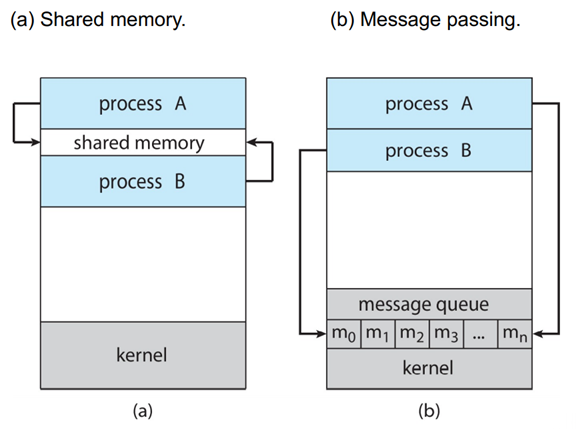
Two models of IPC : Shared memory & Message passing
Producer-Consumer Problem
Paradigm for cooperating processes, producer process produces information that is consumed by a consumer process
Unbounded-buffer places no practical limit on the size of the buffer
Bounded-buffer assumes that there is a fixed buffer size
Interprocess Communication
Shared Memory : An area of memory shared among the processes that wish to communicate
The communication is under the control of the user processes not the operating system
Major issues is to provide mechanism that will allow the user processes to synchronize their actions when they access shared memory
Message Passing : Mechanism for processes to communicate and to synchronize their actions
If processes P and Q wish to communicate, they need to:
Establish a communication link between them, Exchange messages via send/receive
Implementation of communication link :
Physical : Shared memory, hardware bus, network
Logical : Direct or indirect, Synchronous or asynchronous, Automatic or explicit buffering
Direct Communication :
send (P, message) : send a message to process P
receive(Q, message) : receive a message from process Q
A link is associated with exactly one pair of communicating processes
The link may be unidirectional, but is usually bi-directional
Indirect Communication :
send(A, message) : send a message to mailbox A
receive(A, message) : receive a message from mailbox A
Each mailbox has a unique id
Processes can communicate only if they share a mailbox
A link may be associated with many processes
Link may be unidirectional or bi-directional
Synchronization :
Blocking is considered synchronous
Blocking send : the sender is blocked until the message is received
Blocking receive : the receiver is blocked until a message is available
Non-blocking is considered asynchronous
Non-blocking send : the sender sends the message and continue
Non-blocking receive : the receiver receives a valid message, or null message
Buffering :
Zero capacity : no messages are queued on a link. Sender must wait for receiver (rendezvous)
Bounded capacity : finite length of n messages Sender must wait if link full
Unbounded capacity : infinite length Sender never waits
Pipes
Acts as a conduit allowing two processes to communicate
Ordinary pipes : cannot be accessed from outside the process that created it
Typically, a parent process creates a pipe and uses it to communicate with a child process that it created
Ordinary Pipes allow communication in standard producer-consumer style
Producer writes to one end (the write-end of the pipe)
Consumer reads from the other end (the read-end of the pipe)
Require parent-child relationship between communicating processes
Named pipes : can be accessed without a parent-child relationship
Sockets
A socket is defined as an endpoint for communication
Concatenation of IP address and port : a number included at start of message packet to differentiate network services on a host
The socket 161.25.19.8:1625 refers to port 1625 on host 161.25.19.8
'Operating System Design' 카테고리의 다른 글
| Operating System Design - CPU Scheduling (0) | 2021.06.17 |
|---|---|
| Operating System Design - Threads & Concurrency (0) | 2021.06.17 |
| Operating System Design - Operating System Structures (0) | 2021.06.16 |
| Operating System Design - File System Implementation (0) | 2021.06.16 |
| Operating System Design - I/O Systems (0) | 2021.06.16 |


